Cucina di Madre Terra | Cucina di Madre Terra News
By Frank Webb, June 23, 2026
WHEN GEORGIA GATHERED AROUND ITS OWN TABLE
The Forgotten Story of Georgia Products Day and One of the South's Earliest Celebrations of Local Food
More than a century before farm-to-table became a movement… before menus proudly listed the names of local farms… before chefs spoke of seasonality, terroir, and sustainable sourcing… Georgia quietly hosted an extraordinary dinner.
Not in a single city.
Not in a grand ballroom.
But across an entire state.
Not in a grand ballroom.
But across an entire state.
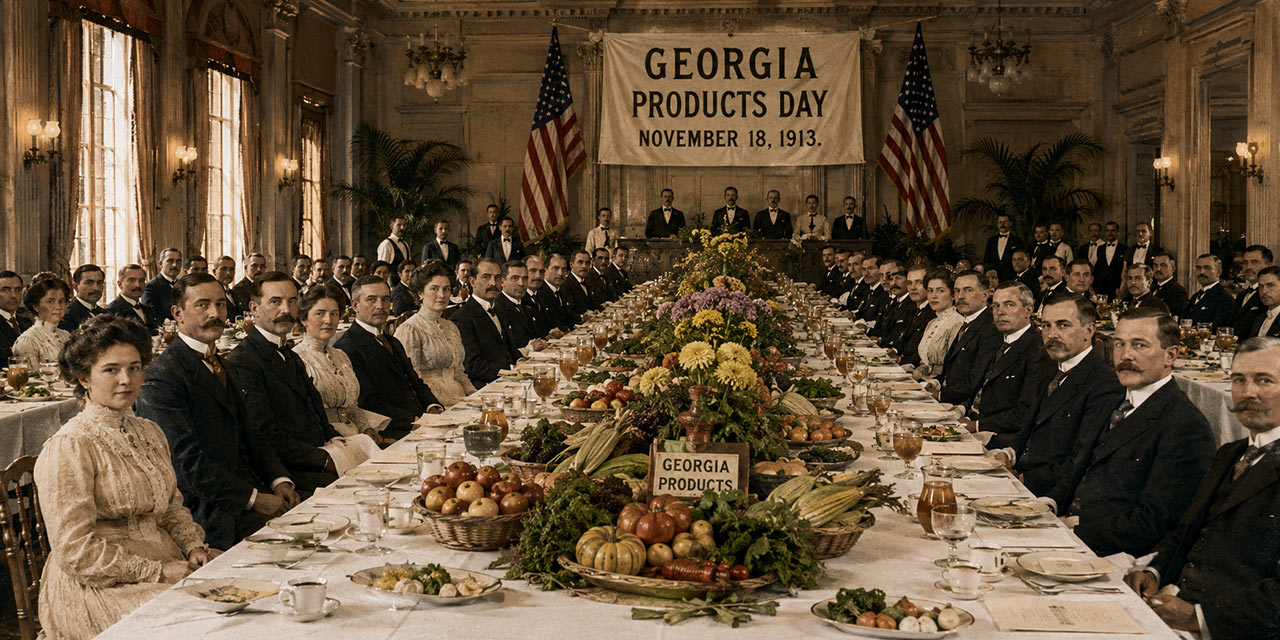
On the evening of November 18, 1913, communities from the Blue Ridge Mountains to the salt marshes of the Georgia coast gathered around tables filled almost entirely with food grown, raised, harvested, or produced within Georgia. Farmers, merchants, civic leaders, manufacturers, educators, hotel owners, and families all shared the same simple idea—that the future of Georgia was inseparable from the richness of its own soil.
Today, that story has largely faded from memory.
Yet viewed through the lens of modern food culture, Georgia Products Day stands as one of the earliest coordinated celebrations of locally produced food in the American South, and perhaps one of the earliest statewide culinary initiatives in the United States built around the idea that local agriculture, local businesses, and local communities thrive together.
"The Date: Tuesday, November 18.
The Place: Everywhere in Georgia.
The Menu: Georgia Products.
The Subject: The Development of Georgia."
The Place: Everywhere in Georgia.
The Menu: Georgia Products.
The Subject: The Development of Georgia."
A STATE SEARCHING FOR ITS FUTURE
The Georgia of 1913 was very different from the one we know today.
Cotton still dominated the economy, but decades of dependence on a single crop had exposed the risks of putting all of the state's hopes into one harvest. Communities were beginning to understand that true prosperity required something more resilient. Georgia's orchards, vegetable farms, dairies, forests, fisheries, livestock producers, and emerging food manufacturers represented tremendous opportunity—but only if Georgians themselves recognized their value.
That challenge inspired the formation of the new Georgia Chamber of Commerce.
Its founders understood that economic development wasn't simply about attracting new industries. It was equally about discovering, appreciating, and supporting the abundance already growing within Georgia's own borders.
Their solution was refreshingly unconventional.
Instead of another conference...
Instead of another policy meeting...
Instead of another report destined for a bookshelf...
They invited an entire state to dinner.
Instead of another policy meeting...
Instead of another report destined for a bookshelf...
They invited an entire state to dinner.
ONE STATE. ONE EVENING. ONE TABLE.
The concept was elegantly simple.
On Tuesday evening, November 18, communities across Georgia would host simultaneous dinners celebrating nothing but Georgia.
Every menu would showcase food grown, raised, harvested, or produced within the state.
Every speech would focus on Georgia's future.
Every gathering would become a conversation about what was possible when a state believed in its own people.
THE NEWSPAPERS ANNOUNCED THE EVENT
The Date: Tuesday, November 18.
The Time: Six o'clock in the evening.
The Place: Everywhere in Georgia.
The Menu: Georgia Products.
The Subject: The Development of Georgia.
The Time: Six o'clock in the evening.
The Place: Everywhere in Georgia.
The Menu: Georgia Products.
The Subject: The Development of Georgia.
Those few lines captured something much larger than a meal.
They described a statewide expression of civic pride rooted not in politics or commerce alone, but in food—the one thing every community shared.
THE TABLE BECAME THE MESSAGE
Momentum spread quickly.
Hotels prepared elaborate Georgia-only menus. Civic clubs organized community banquets. Families who couldn't attend public dinners were encouraged to prepare Georgia-grown meals in their own homes. Storefront windows displayed Georgia products. Manufacturers proudly highlighted goods made within the state. Newspapers published editorials encouraging participation from every corner of Georgia.
The expectation was extraordinary for its time.
A STATEWIDE CELEBRATION
Nearly 100 coordinated dinners.
An estimated 18,000 participants.
Imagine that for a moment.
An estimated 18,000 participants.
Imagine that for a moment.
In an era without television, social media, email, or even widespread automobile ownership, communities hundreds of miles apart came together on the same evening under a shared purpose. They weren't connected by technology.
They were connected by the land beneath their feet.
EVERY PLATE TOLD A STORY
The menus themselves reveal just how ambitious the effort truly was.
Guests might begin with oysters harvested from Georgia's coast before moving to roast turkey, country ham, fresh vegetables, sweet potatoes, turnip greens, butter beans, hominy, locally churned cream, Georgia cheeses, pecans, peaches, preserves, and seasonal fruits. Even the condiments—pickles, jellies, syrups, and jams—celebrated Georgia's farms and food artisans.
Some menus went a step further, identifying the farms, orchards, dairies, or producers responsible for individual ingredients.
Today we celebrate restaurants that proudly tell diners where their food comes from.
Georgia was doing exactly that more than 110 years ago—not as a marketing trend, but as an expression of gratitude and state pride.
MORE THAN LOCAL FOOD
Looking back, it's tempting to describe Georgia Products Day as an early farm-to-table event.
In truth, it was even more ambitious.
Its organizers understood something that economists, community planners, and agricultural advocates still emphasize today: when communities invest in local producers, the benefits ripple far beyond the dinner plate.
A farmer hires local workers.
A restaurant buys from nearby growers.
A processor expands production.
A family business survives another season.
Money circulates within communities instead of leaving them.
A restaurant buys from nearby growers.
A processor expands production.
A family business survives another season.
Money circulates within communities instead of leaving them.
Long before phrases like food systems, regional resilience, or buy local entered our vocabulary, Georgia Products Day recognized that food could become the foundation of stronger local economies.
The meal was symbolic.
The relationships it celebrated were the real purpose.
A CENTURY LATER, THE QUESTIONS HAVEN'T CHANGED
Today's conversations around local food often focus on sustainability, food security, supply chains, transparency, and supporting independent farmers.
Remarkably, many of those same ideas echoed through Georgia's newspapers in 1913, even if they were described in different language.
How do we strengthen rural communities?
How do we support Georgia farmers?
How do we encourage people to value what grows close to home?
How do we ensure that the prosperity created by agriculture benefits the communities that produce it?
How do we support Georgia farmers?
How do we encourage people to value what grows close to home?
How do we ensure that the prosperity created by agriculture benefits the communities that produce it?
Those questions remain as relevant today as they were more than a century ago.
Perhaps that's why Georgia Products Day feels so contemporary.
It reminds us that the farm-to-table movement didn't arrive from somewhere else.
Its roots have been quietly growing here all along.
THE HERITAGE WE SHARE
Southern food has never been defined solely by recipes.
It is defined by place.
By seasons.
By families who learned to coax abundance from difficult soils.
By fishermen reading the tides before sunrise.
By orchard keepers watching another year's crop ripen.
By cheesemakers, millers, beekeepers, ranchers, oyster harvesters, bakers, and cooks whose work connects every meal to a landscape and a community.
Every truly local meal carries those stories with it.
That is the heritage Cucina di Madre Terra exists to celebrate.
The remarkable legacy of Georgia Products Day is not simply that thousands of people gathered for dinner in 1913.
It is that they recognized something profoundly important—that every local ingredient represents a relationship between the land, the people who steward it, and the communities that depend upon both.
More than a century later, that truth remains unchanged.
Perhaps some traditions are not meant to remain in history.
Perhaps they were simply waiting for us to remember them.
Perhaps they were simply waiting for us to remember them.